

How pokies work
A lot goes in to making sure you can’t beat or cheat a pokie machine – from the chair you sit in to the buttons you press.
When you press the spin button, a number is chosen from each virtual reel. These numbers make up a set called the pokie line or payline. To receive any winnings from a spin, the line must match one of the pre-set winning combinations stored in the computer.
If you do have a winning pokie line you will receive a number of credits depending on the prize level. You can either cash these out or keep playing.
Click on the pokie machine below to find out more about how pokies work, and how they keep you hooked.
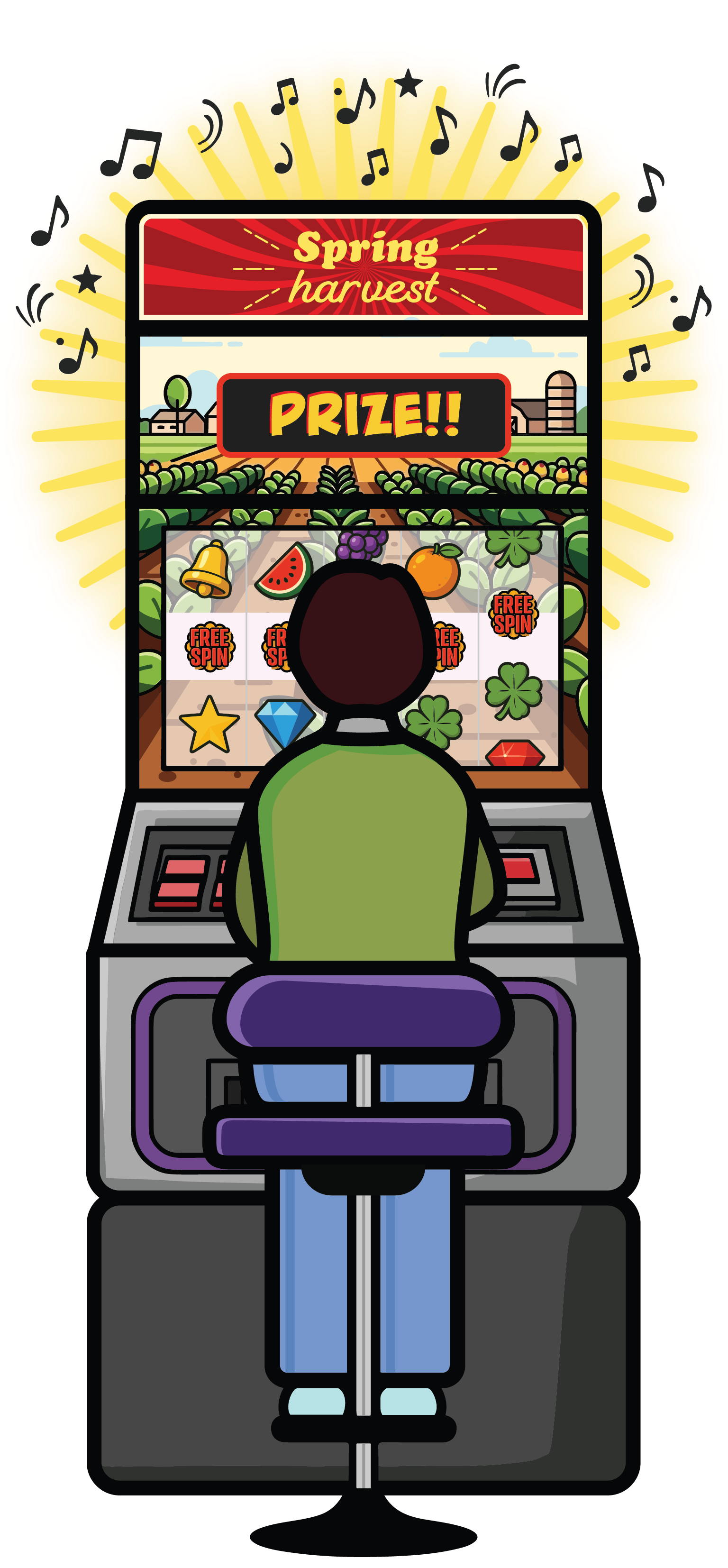
Pokie machine design
Everything from the chair you sit on to the buttons you press has been thought about by experts, with the specific purpose of keeping you playing – and losing.
Losses that feel like wins
Machines have lights and sounds that make it feel like you are winning even when you only get close to a win. But a loss is a loss. The symbols above or below the payline don’t mean anything. They are all random.
Even when you do win, the total you have won is often less than the total you have gambled over the session. Machines celebrate all your wins the same, making it harder to remember that you are losing overall.
Feel the rhythm
Game developers design pokies to keep a rhythmic pace. The steady tempo of clicks and music gives an illusion of predictability – even though the game is random in reality.
That constant soothing tempo helps create the impression that you have some control over the machine when you really don’t.
Bright and immersive worlds
The cabinet and video screen graphics are there to grab your attention. Pokie machines are designed with a wide range of themes and visuals to appeal to different players. Whether the theme is motor racing, farming, adventure or fantasy, the animations play like mini movies, pulling you into the pokie machine world.
Your odds of winning
The odds are always in the game's favour. That is the way it is programmed. There is nothing you can do to improve your odds despite what the game design makes you believe.
Your brain on pokies
Pokies use many different psychological techniques to keep you hooked. Learn more below about what's going on inside your head when using a pokie machine.
Buttons give you confidence
Machine designers position the buttons on the console so you don’t even need to move your hand to push them. Your muscle memory tells your fingers exactly where to go. You quickly learn to play faster, making you feel confident and skilful – as if you are winning the game. But the truth is no combination of button pushes will increase your odds of winning.
Complicated multi-line betting
Old-school pokie machines had just one payline. New machines allow you to bet on many paylines at a time. This complexity makes it almost impossible to keep track of how much you have won and lost. With multi-lines, the odds are that the game will pay out more frequently – but usually for less than the amount of the initial bet. This gives you the sense you’re winning all the time, even if you are not.
Free spins aren’t really free
Free spins give you the feeling you are doing better than you really are. They are just there to make you think you’re getting close to a bigger win. Small wins like free spins are solely designed to keep you playing for longer – they aren’t getting you closer to a big win. And the longer you play, the more likely you are to lose.
Comfy chair keeps you there
If you feel comfortable, you’ll stay in your seat for longer. This is another carefully designed feature, encouraging you to gamble for longer and potentially lose more money.
Sounds too good to be true
Pokie machines use upbeat sounds to keep you playing and feeling good. Wins come with exciting noises – but losses are quiet.
Even when you’re not winning, the constant sound of other machines can trick your brain into thinking a win is coming. These sounds activate the same brain areas as real rewards, making it harder to stop.
Basic psychology
You’ve probably heard of Pavlov’s dogs and his famous studies showing how our brains are wired to seek rewards – even if the reward doesn’t always come.
Pokies use the same psychology to keep you hooked. The machine is programmed to give you enough of a reward to keep you playing. But the machine takes more than it pays out. You cannot beat it.
Dopamine
Pokies trigger a rush of dopamine – the brain chemical linked to rewards and motivation. Too much dopamine can make you crave more play, even when it’s harmful.
Brain scans show that people playing pokies at harmful levels have dopamine spikes similar to those seen in cocaine users. The machines trick your brain into thinking a win is always just around the corner, making it hard to stop.
In the zone
Pokies can make you feel like you’re in a zone where time, money and everything else fades away. The lights, sounds and movement create a kind of trance – like what athletes or musicians feel during peak performance.
Some players get so focused that they don’t notice what’s happening around them – even serious things, like someone collapsing nearby.
False patterns
Our brains are wired to spot patterns, but pokies trick us into seeing patterns that aren’t real. It might seem like the machine is following a pattern, but it is not. Each spin is random. Past results don’t mean anything.
Fast track to addiction
Pokies are much faster to play than other types of gambling. And the more you play, the quicker you get – which can make you feel like you’re getting better at the game. But really, it just means you are losing money faster.
Fast games can be more addictive because you get results quickly. That quick feedback makes you want to keep playing again and again.
Results are always random
It doesn’t matter how experienced a player thinks they are, they can’t have a strategy when the result is completely random.
You’re never “due” for a win. Big wins are programmed to happen only once out thousands or even millions of spins. But each spin is completely random, so playing longer doesn’t get you any closer.
A game of chance, not skill
Pokie machines make you feel like you are in control – choosing bets, lines and when to press the button.
But none of these choices improve your chances. Every spin is random.
Fixed rates of return
Pokie machines are programmed to pay back only part of what you bet – usually between 78% and 92%.
In the short term, you could take a bigger win or experience a bigger loss. But on average, if you insert $1, you can expect to have 66 cents left after 5 spins.
The longer you play, the more you lose
Pokie machines are designed to take in more money than they pay out, so you’re likely to lose more the longer you play.
Even short play can be harmful – but playing for longer increases the risk.